


 Sep 07, 2026
  10 min read
The right auction format depends on what you’re selling, who’s buying, and whether you want bidders seeing each other’s moves. Sealed auctions hide all bids until the end. Open bidding lets everyone see the competition in real time. One creates a level playing field. The other drives prices up through visible momentum. By the end of this post, you’ll know which format matches your situation.
Here’s the thing: most people think all auctions work the same way. They don’t. A government contractor bidding on a road project experiences something completely different than someone bidding on a vintage watch at an auction house. The format matters because it changes how people bid, what they’re willing to pay, and whether you walk away feeling like you got a fair deal.
The choice between sealed and open bidding isn’t about which is objectively better. It’s about which one serves your specific goal. If you’re selling, sealed keeps things fair. If you want higher prices, open bidding creates the competition that pushes them up. If you’re buying, sealed means you bid your true value once. Open means you’re caught in a psychological game where seeing someone else willing to pay more makes you want to pay more too.
This matters whether you’re running a small auction online, bidding on real estate, or managing a government procurement. Pick the wrong format and you either leave money on the table or end up overpaying. Pick the right one and everything flows.
Choose sealed auctions if you want fair pricing without bid manipulation or if your items are niche and attract fewer bidders. Use open bidding when you have multiple competitors fighting for the same item and want the momentum to push prices higher. The format that’s “better” depends entirely on your goal: transparency and fairness, or maximum revenue.
Here’s how to know which you need. If you’re running a government contract bid, hiring a contractor, or buying something where you want to avoid auction psychology inflating prices, sealed bidding is your move. All bids come in secret. No one knows what anyone else offered. The process is fair and documented. You get honest pricing without the drama.
If you’re selling something with real competition, sealed bidding is actually your enemy. Open bidding is where you want to be. When bidders can see other people willing to pay more, they react. Their brain says someone else values this higher, so maybe I should too. That bidding war is what pushes prices up. Sellers who run open auctions consistently see 15-30% higher final prices than sealed auctions for the same items.
The middle ground? It doesn’t exist. You’re either hiding bids or showing them. There’s no hybrid that gives you both secrecy and momentum. So your decision really comes down to one question: Do you care more about the highest possible price, or about running a fair process?
Sealed auctions are simple: bidders submit one bid, no one sees what anyone else bid, and the highest bid wins. The bid envelope stays sealed until the deadline passes. Then everything opens at once.
What happens is this. You write down your number. You seal it. You wait. No changing your mind. No seeing what the competition offers and adjusting. No bidding war that pushes you higher and higher. You make one decision, commit to it, and live with it.
The psychology here is completely different from open auctions. When you bid in sealed format, you’re forced to think hard about your actual maximum. What’s this really worth to you? Not what’s it worth compared to someone else’s bid, but what’s it genuinely worth in your life or business? That number is usually lower than it would be if you were watching competitors drive the price up in real time.
Let’s say you’re bidding on a contract to renovate three office buildings. You sit down, look at the scope of work, calculate your labor costs, materials, timeline, and profit margin. You come up with $485,000. That’s your sealed bid. You submit it. You don’t know if the next contractor bid $400,000 or $600,000. You’ll find out when the bids open, but by then it’s done.
The moment the deadline hits, the auctioneer or the system stops accepting bids. It’s like a door slamming shut. No more submissions. No more chances to change your mind. The timing is strict because sealed auctions are all about finality.
Then comes opening day. All the sealed bids get announced publicly. The auctioneer reads them aloud or posts them online. Highest bid wins. No second place gets a chance to counter-bid. No one gets to say “Wait, I can beat that.” It’s decided.
Here’s what makes this format feel formal and serious. Because it is. There’s no room for negotiation once bids are opened. There’s no auction theater or drama. Just numbers, decision made, process complete.
Real-world example that matters: Government contracts use sealed bidding for everything from road construction to supply contracts. Here’s why. A state transportation department needs to build a bridge. They can’t have the bid process influenced by who’s in the room or how aggressive one contractor acts during live bidding. They need fairness. They post the project details. Contractors submit sealed bids by a specific date and time. On opening day, all bids are announced publicly. The lowest responsible bid usually wins (for government, price is the main factor, not highest bid like consumer auctions).
This prevents corruption. It prevents anyone from knowing what their competitors bid until it’s officially over. Everyone competes on the same playing field.
The sealed format also means there’s no buildup. No tension. No adrenaline. Some people love this because it removes emotion. Other people hate it because they want the excitement of bidding.
If you’re bidding on something where you’ve thought through exactly what it’s worth, sealed auctions work great. You bid that number. Done. If you’re someone who likes to see where you stand against competition, or who wants the chance to adjust based on what others bid, sealed auctions are frustrating because you don’t get that information until it’s too late.
The bigger picture: sealed auctions exist because they solve a specific problem. They remove the possibility of irrational bidding driven by competition psychology. They create a documented process that anyone can audit. They feel fair because they are fair. Both things matter when you’re dealing with real money, government contracts, or situations where people need to trust the outcome.
Open bidding is straightforward. The auctioneer announces an item. Someone opens at a starting price. Another person bids higher. The first bidder counters. It keeps going up until nobody wants to bid anymore. Everyone sees every bid in real time.
That visibility is everything. When you see someone else willing to pay more, something shifts in your head. You think: if they value it that high, maybe I’m underestimating what it’s worth. So you bid higher. They bid higher back. Now you’re locked in a competition you didn’t plan for.
This is the bidding war effect. It’s not rational. You’re no longer bidding based on what the item is actually worth to you. You’re bidding based on beating the person next to you. That psychological shift is what pushes prices up.
Take eBay. You spot a vintage camera and bid $50. Someone counter-bids $55. You see it and think, “I’m not losing this.” So you bid $65. They go $72. Now you’re at $72 for something you originally valued at $50. The format made you overpay.
Open bidding also creates urgency. In live auctions, the auctioneer accelerates the pace. “Do I hear $100? Going once. Going twice.” In online auctions, there’s a countdown timer. Five minutes left. Bidding is active. People jump in fast. They don’t want to miss out.
The real-world result: open auctions consistently pull higher prices than sealed bidding for the same items. Why? Not because the items are worth more. Because the format triggers competition, and competition drives prices up.
Here’s the trade-off. If you’re selling, this is perfect. If you’re buying, you might end up spending more than you planned because you got caught in the moment.
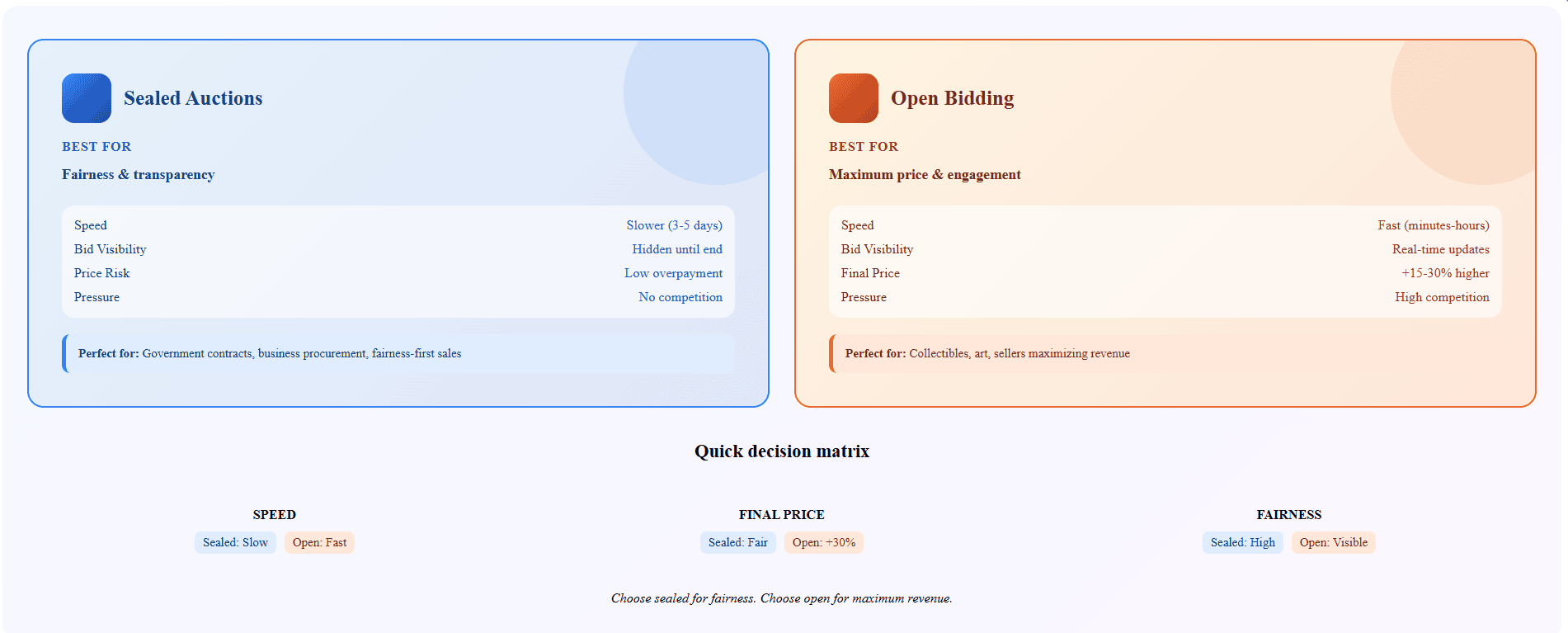
Sealed auctions are slower. You announce the bidding period, collect bids, set a date to open them, and then reveal everything at once. Three to five days minimum. Sometimes longer if you’re dealing with mail-in bids or government processes.
Open bidding is fast. Live auctions finish in minutes or hours. Online bidding platforms update in seconds. You can run multiple auctions in a single day.
Here’s why speed matters. If you need a decision made today, open bidding wins. You start the auction, bidders compete, it’s over. Done. If you have time and want to follow a formal process, sealed auctions work fine. Nobody’s rushing.
Now the transparency part. This is where things get interesting.
Sealed auctions hide everything until the end. Nobody knows what anyone else bid. No one sees the competition. The process looks secretive to outsiders, but it’s actually fair. All bids are public once they open. Fully transparent at that moment. Everything gets documented. You can audit it. You can prove no favoritism happened.
Open bidding is transparent the whole time. Everyone watching sees the current high bid. They see the bidding history. They know exactly what’s happening right now. No surprises at the end because you’ve been watching it happen.
Which one feels more transparent depends on your perspective. Sealed auctions feel secretive while bidding is happening, then completely open at the end. Open auctions are transparent throughout, but that constant visibility is also what makes people overpay.
For government contracts and formal procurement, sealed wins on transparency because everything’s documented and auditable. For consumer auctions and sales, open wins because bidders see what they’re competing against in real time.
If you’re buying something and you want to know where you stand right now, open bidding gives you that. If you’re running a formal process where fairness and documentation matter more than speed, sealed bidding is your move.
The practical difference: sealed auctions take longer but feel safer and more formal. Open auctions are quick and engaging, but the constant visibility makes people bid emotionally instead of rationally.
Use sealed auctions when fairness matters more than price maximization.
Government and public sector work. Most government contracts require sealed bidding by law. It prevents favoritism. It stops bids from being influenced by what competitors bid. It’s fair and documented. A city needs road repairs. They post specs. Contractors submit sealed bids. On opening day, all bids are public. The lowest responsible bid wins. Everyone knows the process was fair.
Niche or specialty items. If you’re auctioning something only a handful of people care about, sealed auctions reduce manipulation risk. A serious collector won’t see casual spectators bidding and decide to overpay. Each person bids their true value once.
Selling to businesses. Companies want one fair price without auction theater. A sealed bid process feels professional. It’s used all the time in construction, consulting, and supplier negotiations. You get a quote, they get a quote, everybody bids blind. Most professional outcome.
You want to avoid shill bidding. Shill bidding is when someone bids artificially just to drive up the price. Sealed auctions make this harder because no one knows what bids are coming in until it’s over. You can’t see a fake bid and react to it.
You’re buying and want to protect yourself. If you’re the buyer running a sealed bid process for contractors or services, you control the outcome. Bids come in, you evaluate them fairly, you pick the best value. No surprise price spikes from competition psychology.
Use open bidding when you want maximum price and buyer engagement.
You have multiple competitive bidders. If five people want the same item, open bidding makes them compete visibly. They’ll keep raising bids. Sealed bidding won’t get that same effect because each person bids once, privately. The competition visibility is what pushes prices up.
You’re selling collectibles or art. The auction drama is part of the appeal. People come for the experience. Watching bids climb builds excitement. That excitement translates to higher prices. A painting estimated at $5,000 can sell for $12,000 in open bidding because the competition made people emotional.
You want to move inventory fast. Live or online open auctions create urgency. People bid faster. Momentum carries them. You can run multiple auctions in a day and clear stock quickly.
You trust your audience. Open bidding assumes honest bidders. If you’re selling to a community you know, open bidding builds engagement. People feel the fair play. The transparency makes them trust the process because they see everything happening in real time.
You’re selling at scale. If you run auctions regularly (eBay sellers, auction houses, antique dealers), open bidding is your standard. Buyers expect it. They’re comfortable with it. They know how it works. Sealed bidding would confuse your customer base.
You want to maximize seller revenue. Open auctions generate 15-30% higher prices than sealed auctions for identical items. If your goal is revenue, not fairness, open bidding wins every time. The format itself makes people bid higher.
The right auction format depends on what you’re trying to achieve. Choose sealed auctions if fairness and formal process matter more than price. Choose open bidding if you want maximum revenue and buyer engagement. Know your goal upfront, communicate the rules clearly, and stick to them. That’s what makes an auction work.


Nitesh Singh is an e-commerce software architect and the Founder of Inception Software LLP. He has 16+ years of software engineering experience and has been building dedicated auction extensions for the WordPress and WooCommerce ecosystems since 2014. Connect with Nitesh on LinkedIn to track his latest developments in automated bidding tech or read his setup guides on the site.
More articles by Nitesh Singh →


 Easy Setup
 5 Star Support