


 Aug 12, 2026
  15 min read
Starting an online auction business isn’t as complicated as it sounds, but it’s not “install a plugin and wait for money” either. At its core, you pick a niche, choose where to run your auctions, set up the platform and the payment and legal basics, then do the hard part: getting real buyers and sellers to show up. This guide walks through all of it in 2026, the practical steps, the real costs, and the honest trade-offs, so you can decide if it’s worth building and how to actually do it.
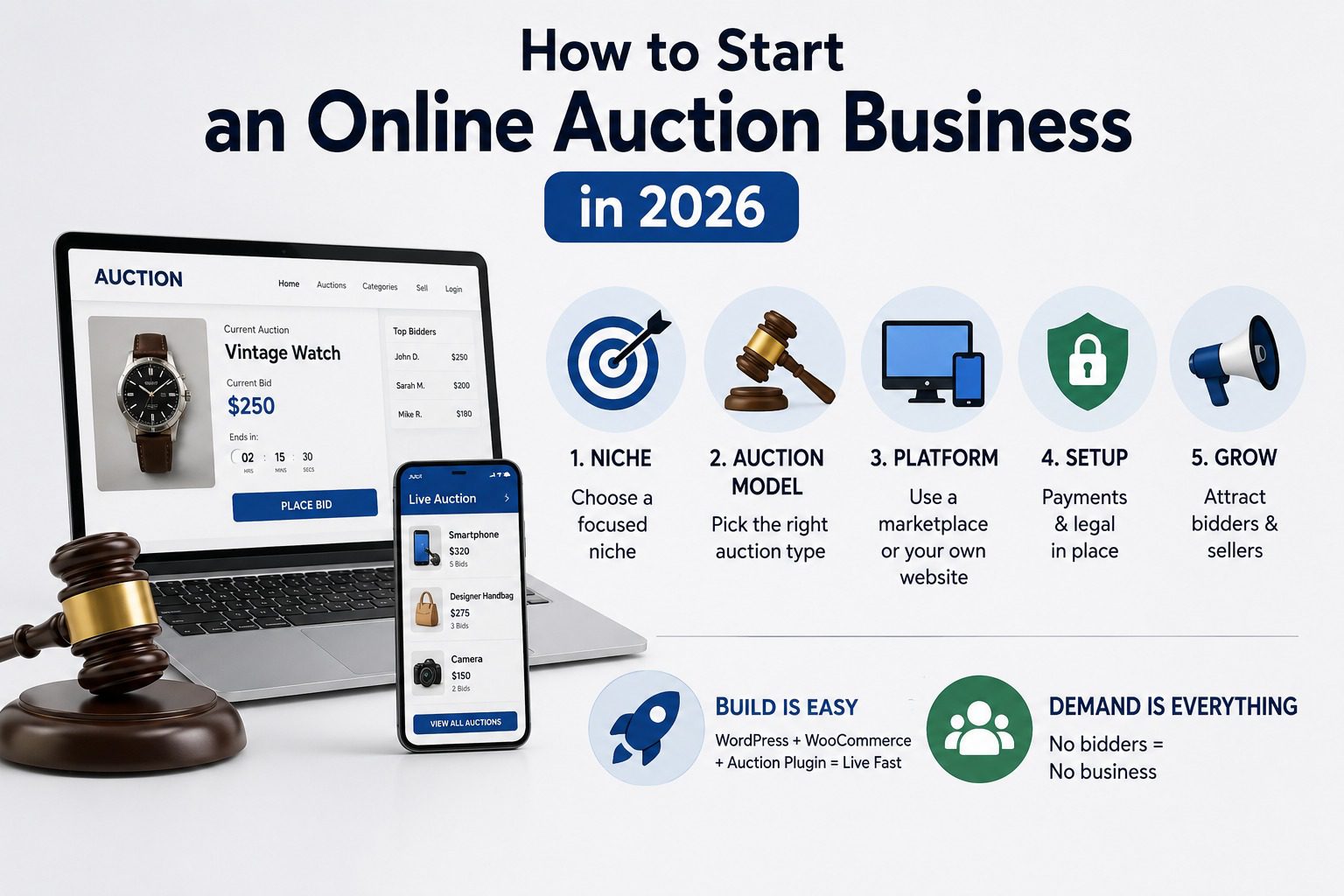
To start an online auction business, you need five things: a focused niche, an auction model (standard, reverse, sealed-bid, and so on), a platform to run it on (an existing marketplace or your own website), the payment and legal setup to take money safely, and a plan to attract bidders and sellers. The build itself is the easy part now. WordPress with WooCommerce and an auction plugin gets a site live without a developer. The real work is demand: an auction with no bidders is just an empty listing.
Short answer: yes, but only if you go in with realistic expectations. The demand is real, the overhead is low, and the tools are cheaper and easier than they’ve ever been. What trips people up isn’t building the site, it’s filling it.
Start with the demand, because that part is genuine. Online auctions are a growing market, though you’ll see wildly different numbers depending on who’s measuring and how they define it. One recent industry forecast values the global online auction market at around $14 billion in 2026, growing to roughly $21.6 billion by 2035. Other firms put it far higher by folding in all marketplace sales. The exact figure is less important than the direction, which every source agrees on: it’s growing, and it’s increasingly mobile. So you’re not betting on a dying format.
The appeal for a new business is the economics. Compared to holding inventory and selling at fixed prices, an auction model has real advantages. You don’t need to guess the right price, bidders set it. A deadline creates urgency that a “buy now” button doesn’t. And if you run a multi-vendor marketplace, other people supply the inventory while you take a commission, so you can start without a warehouse full of stock.
Now the honest part, because this is where most “start an auction business” guides go quiet. The hard problem isn’t technical, it’s the cold start. An auction only works with bidders, and bidders only show up when there’s something worth bidding on. Early on you have neither, and solving that chicken-and-egg problem is the actual job. It’s why a tightly focused niche beats a general site: it’s far easier to gather a small, passionate crowd around one category than a big crowd around everything.
So is it worth it? If you want fast, passive income, no. If you’re willing to pick a niche, seed the first listings, and put in the work to attract a community, then yes, the model is sound, the costs are low, and the market is on your side.
Pick your niche before anything else. This is the decision that determines whether your first auction gets ten bidders or none.
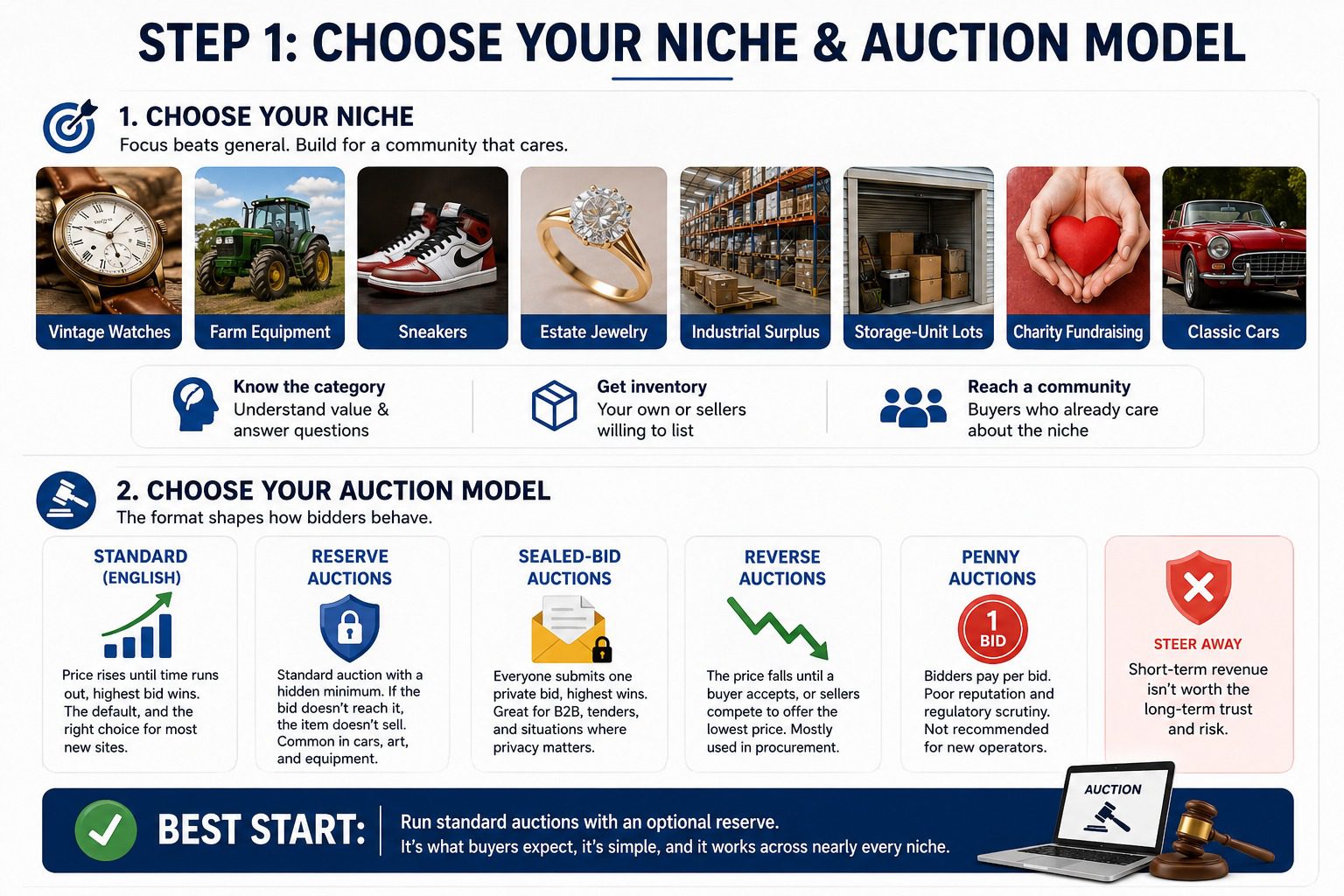
A general auction site competing with eBay is a losing plan. You can’t out-inventory them, and you won’t out-market them. But a focused site can win, because a small, passionate community is far easier to gather than a big general one. Vintage watches, farm equipment, sneakers, estate jewelry, industrial surplus, storage-unit lots, charity fundraising, classic cars. Each has buyers who already gather somewhere and would rather bid among people who know the category than shout into a general marketplace.
Choose based on three things: do you know the category well enough to spot value and answer questions, can you get inventory (your own, or sellers willing to list), and is there a community you can reach. If you can’t answer all three, pick a different niche.
Then choose your auction model, because the format shapes bidder behavior:
Standard (English) auctions. Price rises until time runs out, highest bid wins. The default, and the right choice for almost everyone starting out. Bidders understand it instantly.
Reserve auctions. A standard auction with a hidden minimum. If bidding ends below it, the item doesn’t sell. Useful when sellers can’t afford to let valuable items go cheap, common in cars, art, and equipment.
Sealed-bid auctions. Everyone submits one private bid, highest wins. Suits B2B, tenders, and situations where you don’t want bidders reacting to each other.
Reverse auctions. The price falls until a buyer accepts, or sellers compete to offer the lowest price. Mostly a procurement model, not a consumer one.
Penny auctions. Bidders pay per bid. It’s legal in many places but has a poor reputation and draws regulatory scrutiny, so I’d steer new operators away from it. The short-term revenue isn’t worth the trust cost.
For most people the answer is straightforward: run standard auctions with an optional reserve. It’s what buyers expect, it’s simplest to explain, and it works across nearly every niche. Get that running before experimenting with anything else.
This is the fork that shapes everything else, and there’s no universally right answer. It comes down to whether you want reach or control.
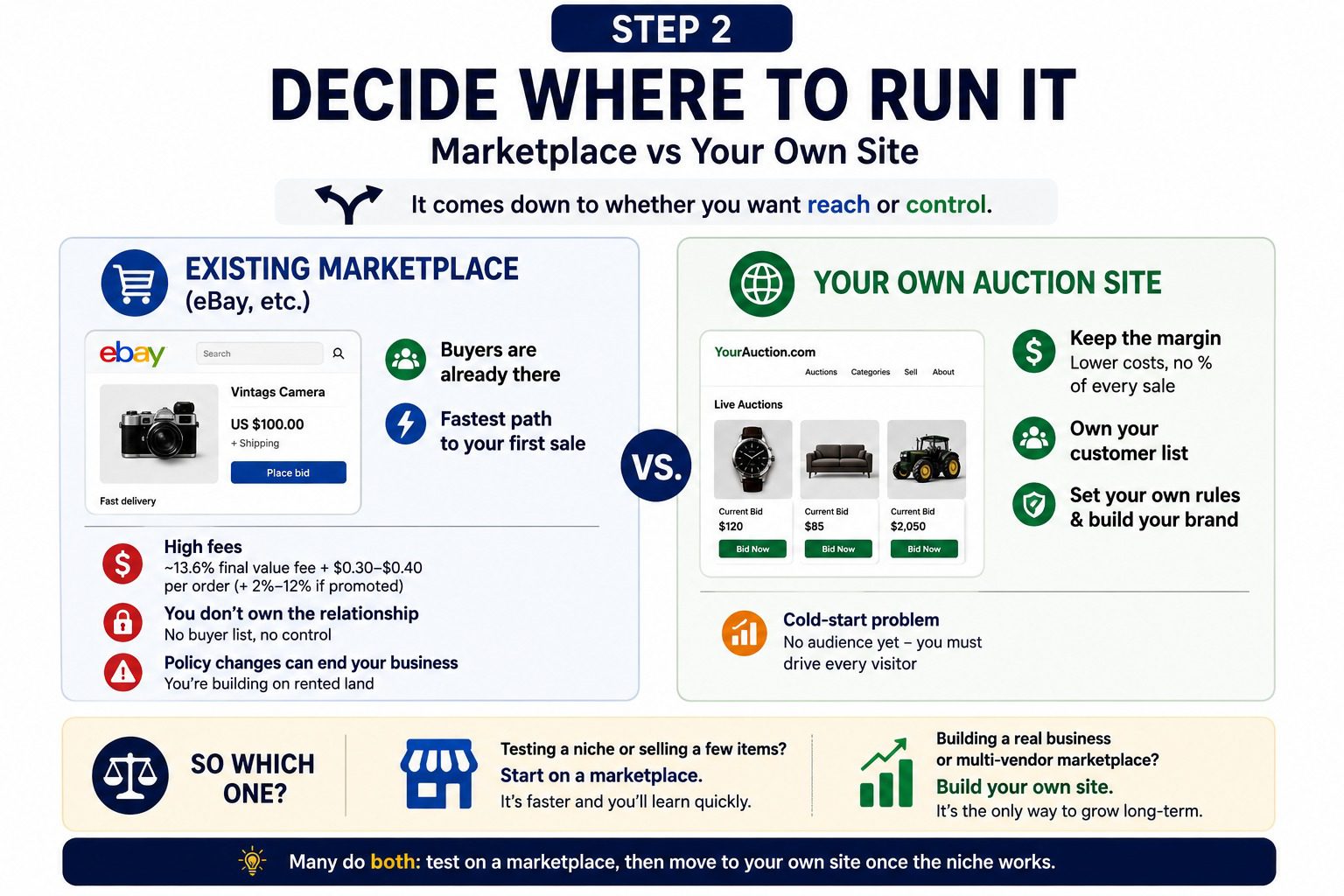
Running auctions on an existing marketplace means listing on eBay or a similar platform. The advantage is obvious: the buyers are already there. You don’t have to solve the cold-start problem, because millions of people are already browsing. For testing a niche or selling a handful of items, it’s the fastest path to a first sale.
The cost is that you’re renting someone else’s audience, and the rent is high. On eBay, most categories carry a final value fee of 13.6% of the total sale, plus a per-order fee of $0.30 to $0.40. That fee is calculated on the item price plus shipping and tax, not just the item. Push visibility with Promoted Listings and you’re adding another 2% to 12% on top. So on a $100 sale you’re often keeping around $86, and less if you advertise.
You also don’t own the relationship. You can’t email your buyers freely, you don’t control the rules, and a policy change or account issue can end your business overnight. You’re building on rented land.
Running your own auction site flips both sides of that. You keep the margin, since your costs are hosting, a plugin, and payment processing rather than a percentage of every sale. You own your customer list, set your own fees and rules, and build a brand that’s yours. If you run a multi-vendor marketplace, you’re the one collecting commission instead of paying it.
The trade-off is that nobody knows you exist. You’re responsible for every visitor, and that cold-start problem from earlier is entirely yours to solve. It’s more work up front, and slower at the start.
So which one? If you’re testing whether a niche has demand, or you just want to sell some items, start on a marketplace. It’s faster and you’ll learn quickly. If you’re building an actual business, especially a multi-vendor marketplace where others list and you take commission, your own site is the only version that works long-term, because the marketplace fees make thin margins impossible and you can’t build a brand on someone else’s platform.
Plenty of people do both: test on a marketplace, then move to their own site once they know the niche works. That’s a sensible path, and it’s how a lot of auction businesses actually start.
If you’ve chosen your own site, this is the part people assume is hardest. It isn’t. You don’t need a developer or a custom build, and you shouldn’t start with one.
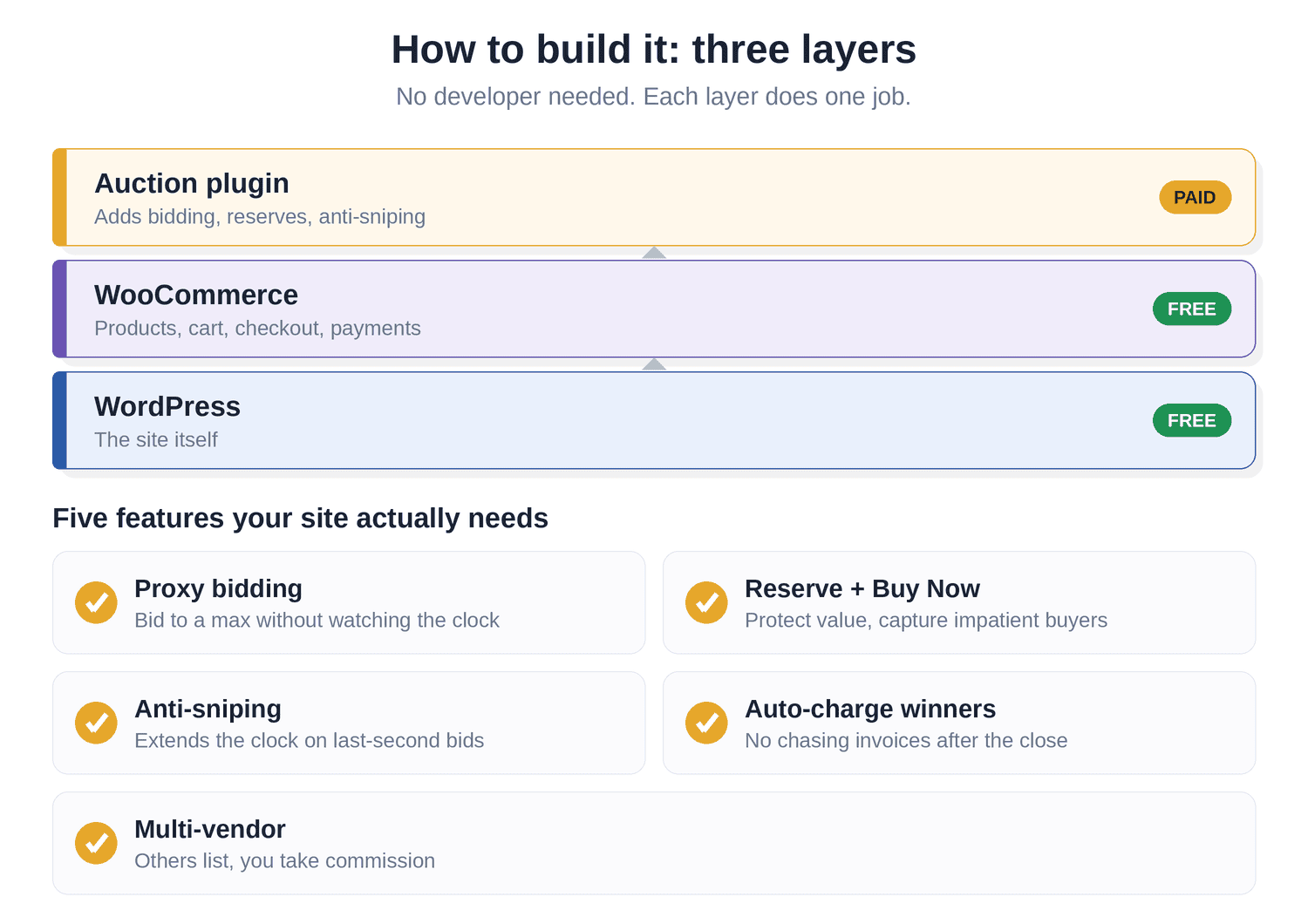
The practical path for most people is WordPress with WooCommerce and an auction plugin. WordPress runs the site, WooCommerce handles products, carts, and checkout, and the auction plugin adds bidding on top. All three are mature, well-documented, and cheap enough that you can be live for the cost of hosting and a plugin licence rather than a five-figure development bill. That’s why it’s the default route for new auction businesses.
Whatever you build on, these are the features that decide whether your site actually works:
Proxy bidding. Bidders enter a maximum and the system bids on their behalf up to that limit. It’s what lets people participate without watching the clock, and its absence is felt immediately.
Reserve and Buy Now. A reserve protects sellers on valuable lots. Buy Now captures the buyer who doesn’t want to wait. Most niches want both.
Anti-sniping (soft close). When a bid lands in the final seconds, the auction extends. Without it, lots get stolen at the buzzer for barely above the previous bid, and both sellers and bidders end up frustrated.
Automatic payment collection. This is the one new operators underestimate. If winners have to be invoiced manually, you will spend your week chasing people who changed their mind overnight. Charging the winner’s card automatically when the auction closes removes the single most tedious part of running auctions.
Multi-vendor support, if others will list on your site. You need vendor dashboards, commission handling, and a way for sellers to manage their own auctions. If your model is “other people supply the inventory,” this isn’t optional.
On our side, Ultimate Auction Pro is built around exactly this list, WooCommerce-based, with proxy bidding, soft-close anti-sniping, automatic winner charging across several gateways, and multi-vendor through the free WCFM marketplace. It’s the plugin we make, so weigh that accordingly, but the feature list above is what any auction platform needs, whichever tool you choose. There are other options worth comparing, and the right one depends on whether you’re running a single-seller site or a full marketplace.
One piece of practical advice: launch with less than you think you need. A working site with standard auctions, reserves, and automatic payment beats a half-finished site with every feature. You can add complexity once real bidders are using it.
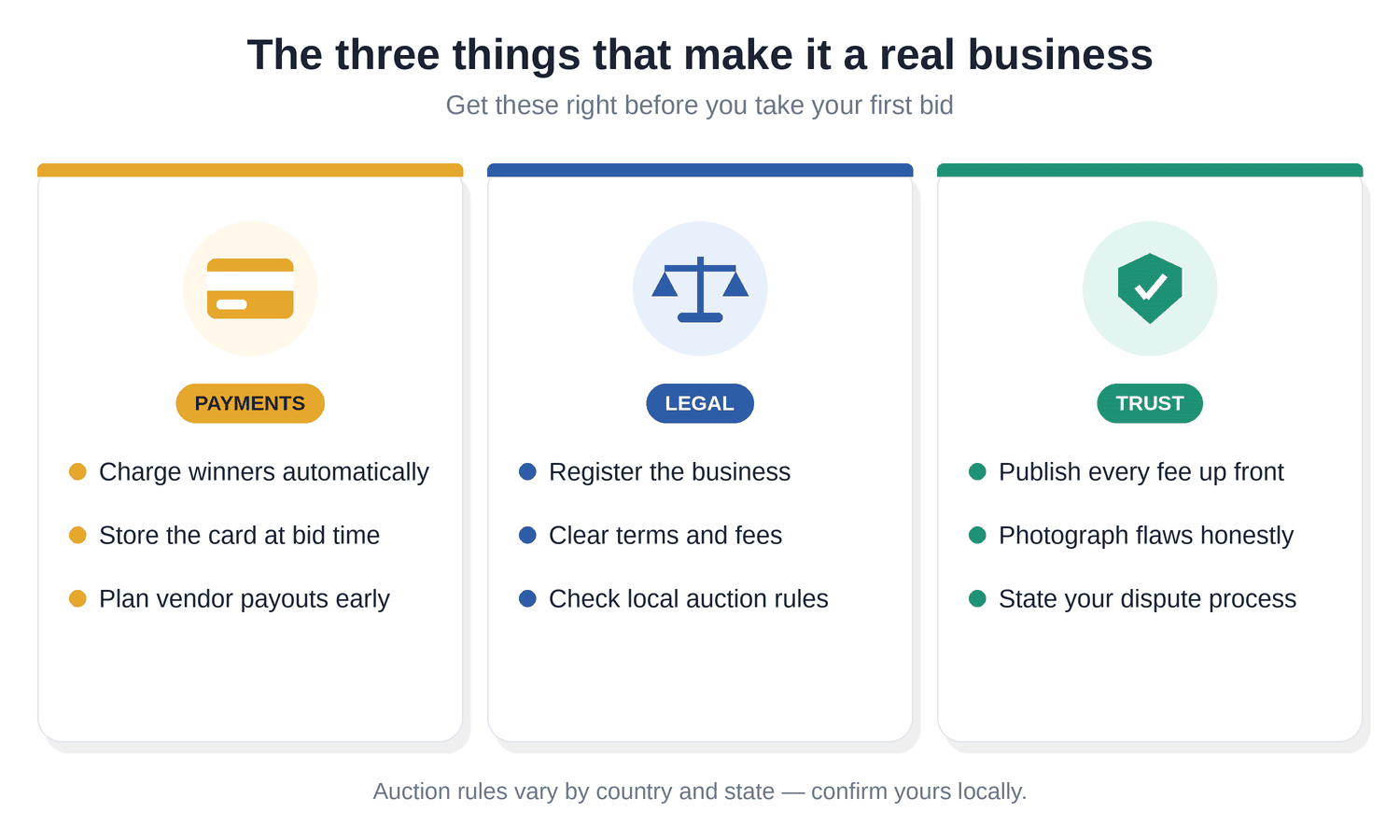
This is the unglamorous step that separates a real business from a hobby site, and it’s where most guides wave vaguely and move on. Get it wrong and you’ll find out at the worst possible moment.
Payments. You need a way to take money reliably, and for auctions specifically, you want to charge the winner automatically when bidding ends. Stripe is the common starting point, with Square, Braintree, and Paystack as alternatives depending on your country. Two things matter beyond just connecting a gateway. First, whether you can store a card at bid time and charge it at close, because that’s what stops non-paying winners. Second, if you’re running a multi-vendor marketplace, how money splits between you and your sellers, whether the platform collects everything and pays out commission, or funds go straight to vendors. Decide that before you launch, not after your first vendor asks where their money is.
Legal. I’m not a lawyer, and auction law genuinely varies by country and often by state or province, so treat this as a checklist to take to someone qualified rather than advice. The recurring items are: registering your business properly, writing clear terms and conditions that spell out fees, payment deadlines, and what happens when a winner doesn’t pay, and checking whether your jurisdiction requires an auctioneer licence or registration for online auctions. Some places regulate online auctions lightly, others treat them like traditional auctioneering. Consumer protection rules, distance-selling rights, and tax obligations also apply, and they differ depending on where your buyers are, not just where you are. The cost of asking a local professional once is far lower than the cost of finding out later.
Trust. In an auction, buyers hand over money for something they haven’t held, often to a site they’ve never used. Everything that reduces that anxiety directly increases your bids. Publish your fees clearly, including the buyer’s premium if you charge one, so nothing appears at checkout that wasn’t visible at bid time. Write an honest, specific description of every lot and photograph flaws rather than hiding them. State your dispute and refund process before anyone needs it. And use real seller verification if you’re running a marketplace, because one bad vendor damages trust in your whole platform.
None of this is exciting, but it’s the difference between a site people bid on twice and one they bid on once.
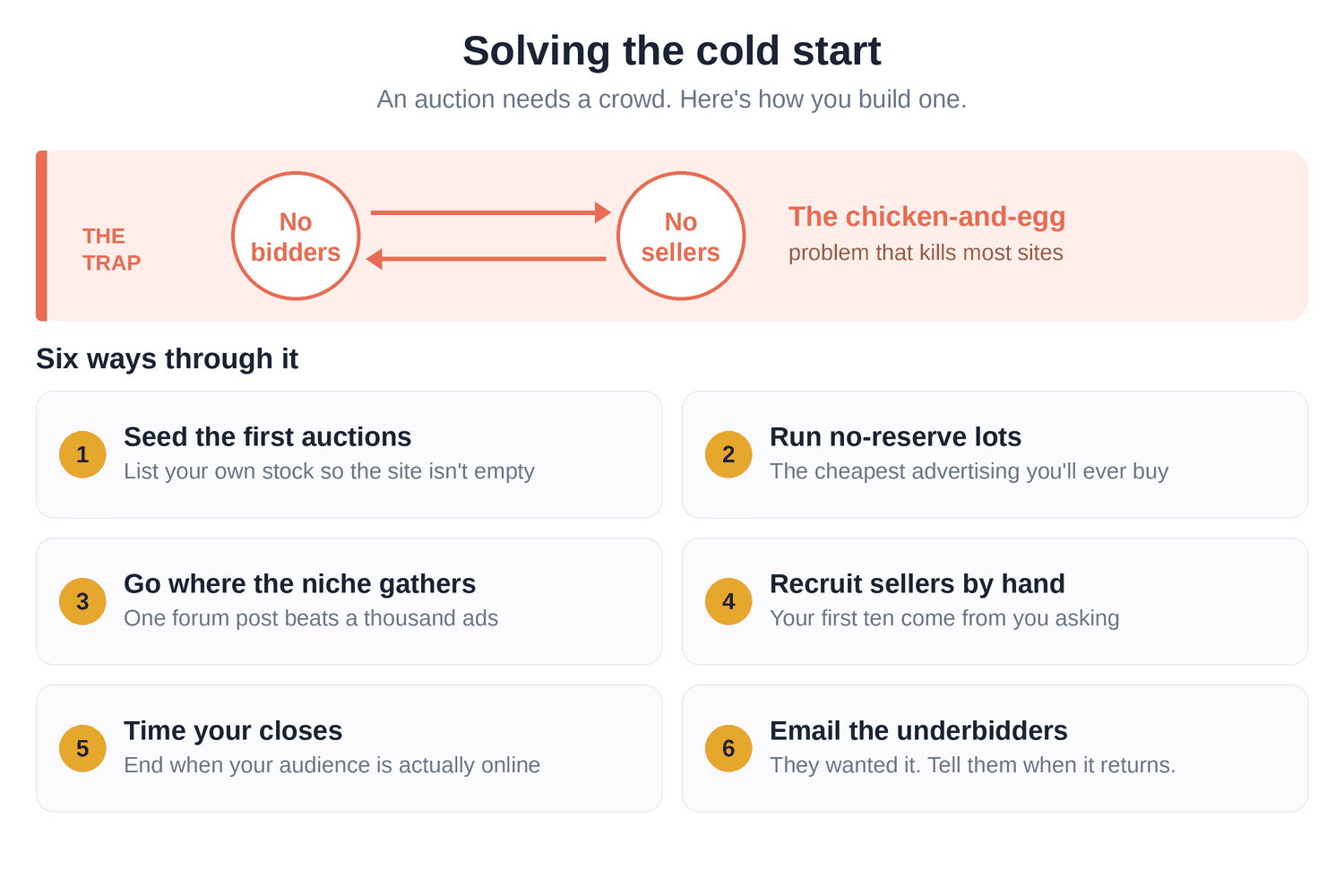
Here’s the part nobody warns you about. You’ll build the site in a weekend and then spend six months on this.
An auction needs a crowd. One bidder isn’t an auction, it’s a fixed-price sale where you set the price too low. But bidders won’t turn up for an empty site, and sellers won’t list where there are no bidders. That’s the cold start, and it kills more auction businesses than any technical problem.
The way through it is to stop thinking big. Don’t launch a general auction site. Launch the auction site for one thing, and make it small enough that you can personally reach most of the people who care about it.
Seed the first auctions yourself. Don’t wait for sellers. Buy or source inventory in your niche and run those first auctions from your own account. You need listings on the site before anyone will take it seriously, and you’ll learn how your own platform behaves under real bidding.
Start a few lots at no reserve. A no-reserve auction is the cheapest advertising you’ll ever run. People show up because a genuine bargain might happen. You might lose a little on those first lots. Treat it as a marketing cost, because that’s what it is.
Go where your niche already gathers. Not “do social media marketing.” Find the specific forum, the Facebook group, the subreddit, the Discord, the local club where these people already talk to each other. Participate honestly, don’t spam, and mention what you’re building when it’s relevant. One well-placed post in a community of 3,000 obsessives beats a thousand generic impressions.
Recruit sellers one at a time. Your first ten sellers will come from you personally asking them, not from a signup form. Talk to dealers, collectors, and small businesses in your niche, and be direct about what you’re offering: lower fees than the big marketplaces, and buyers who actually care about their category.
Time your closes. Ending auctions when your audience is awake and browsing makes a real difference. Evenings and weekends usually beat a Tuesday morning, but it depends on who you’re selling to. Watch your own data and adjust.
Email the people who lost. Underbidders are your most valuable list. They wanted the item and were willing to pay. When something similar lists, tell them. This one habit does more for repeat bidding than most paid advertising.
Expect the first few auctions to be quiet. That’s normal, and it isn’t a sign the idea is broken. The sites that work are the ones that kept listing while the numbers were embarrassing, and got a little less embarrassing each week.
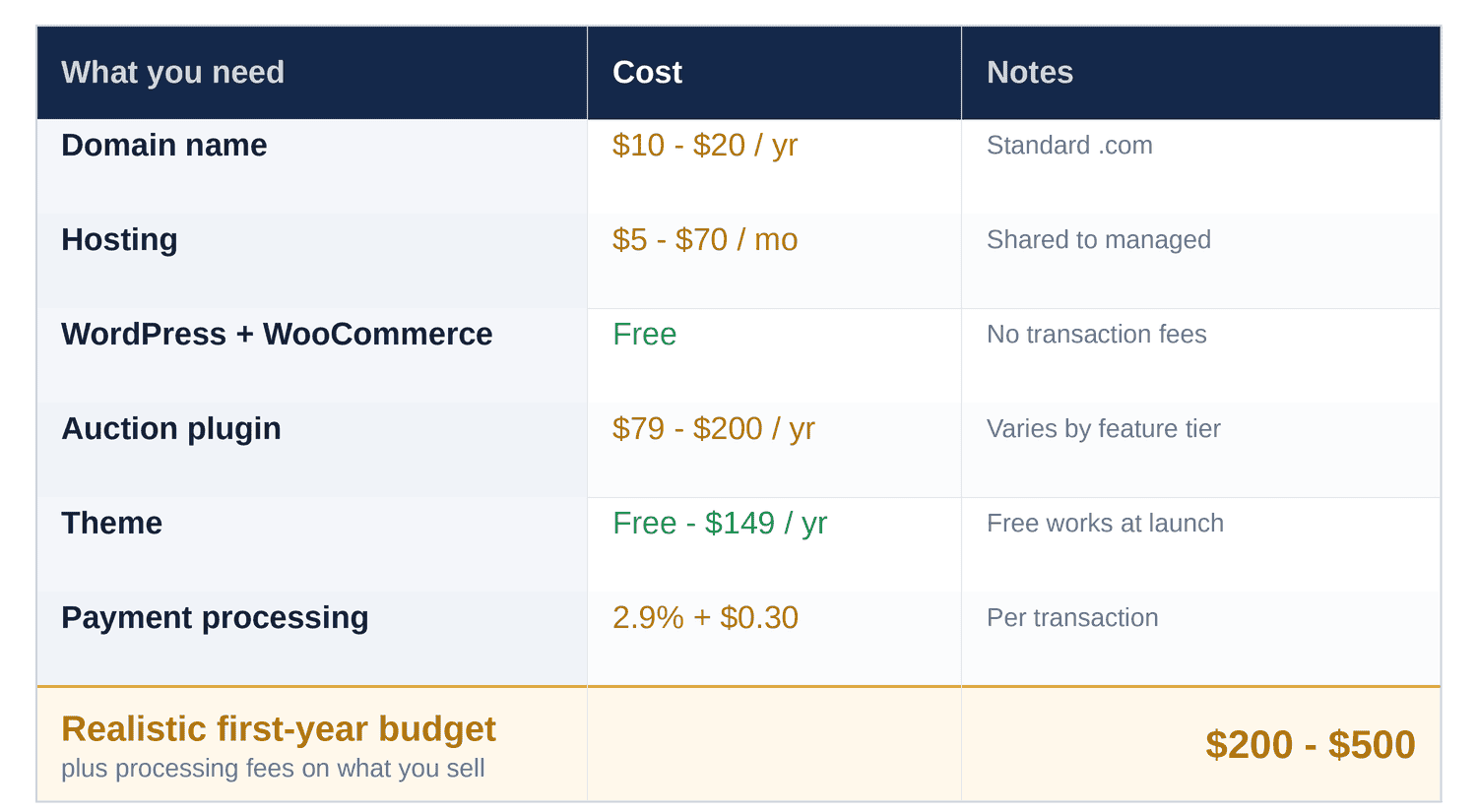
Less than most people expect, if you build it yourself. Here’s the honest breakdown for a WordPress and WooCommerce setup.
Domain name: $10 to $20 a year. A standard .com. Nothing complicated here.
Hosting: $5 to $70 a month. This is where budgets vary most. Basic shared hosting starts around $5 a month and is fine while you’re finding your feet. Managed WooCommerce hosting runs $25 to $70 and becomes worth it once real traffic and simultaneous bidding arrive. Auctions are more demanding than a normal store, because bidders all hit the site at once in the final minutes, so don’t cheap out here forever.
WordPress and WooCommerce: free. Both are open source. WooCommerce charges no transaction fee of its own, which is a genuine advantage over hosted platforms.
Auction plugin: roughly $79 to $200 a year. This is your core functionality, and prices vary by feature tier. Check what’s actually included at each level, since automatic payment collection and multi-vendor support often sit above the entry plan.
Theme: free to $149 a year. Free themes work perfectly well at launch. Spend here later, not first.
Payment processing: 2.9% plus $0.30 per transaction. This is the ongoing cost that scales with you. Stripe and most gateways charge the same standard rate, with roughly 1% to 1.5% extra on international cards. On $10,000 of monthly sales, that’s around $320 a month.
So a realistic starting budget is about $200 to $500 for your first year, plus processing fees on whatever you sell. Compare that to marketplace fees: at eBay’s 13.6% on most categories, $10,000 in sales costs you around $1,360, versus roughly $290 in processing on your own site. The break-even arrives faster than people assume.
Two costs that don’t appear on this list but will hit you anyway. Marketing, because a site nobody knows about doesn’t sell, and your time, which for the first few months is the biggest investment by far. Budget both honestly.


Nitesh Singh is an e-commerce software architect and the Founder of Inception Software LLP. He has 16+ years of software engineering experience and has been building dedicated auction extensions for the WordPress and WooCommerce ecosystems since 2014. Connect with Nitesh on LinkedIn to track his latest developments in automated bidding tech or read his setup guides on the site.
More articles by Nitesh Singh →


 Easy Setup
 5 Star Support