

 Jul 28, 2026
  6 min read
Start with the one fact that matters
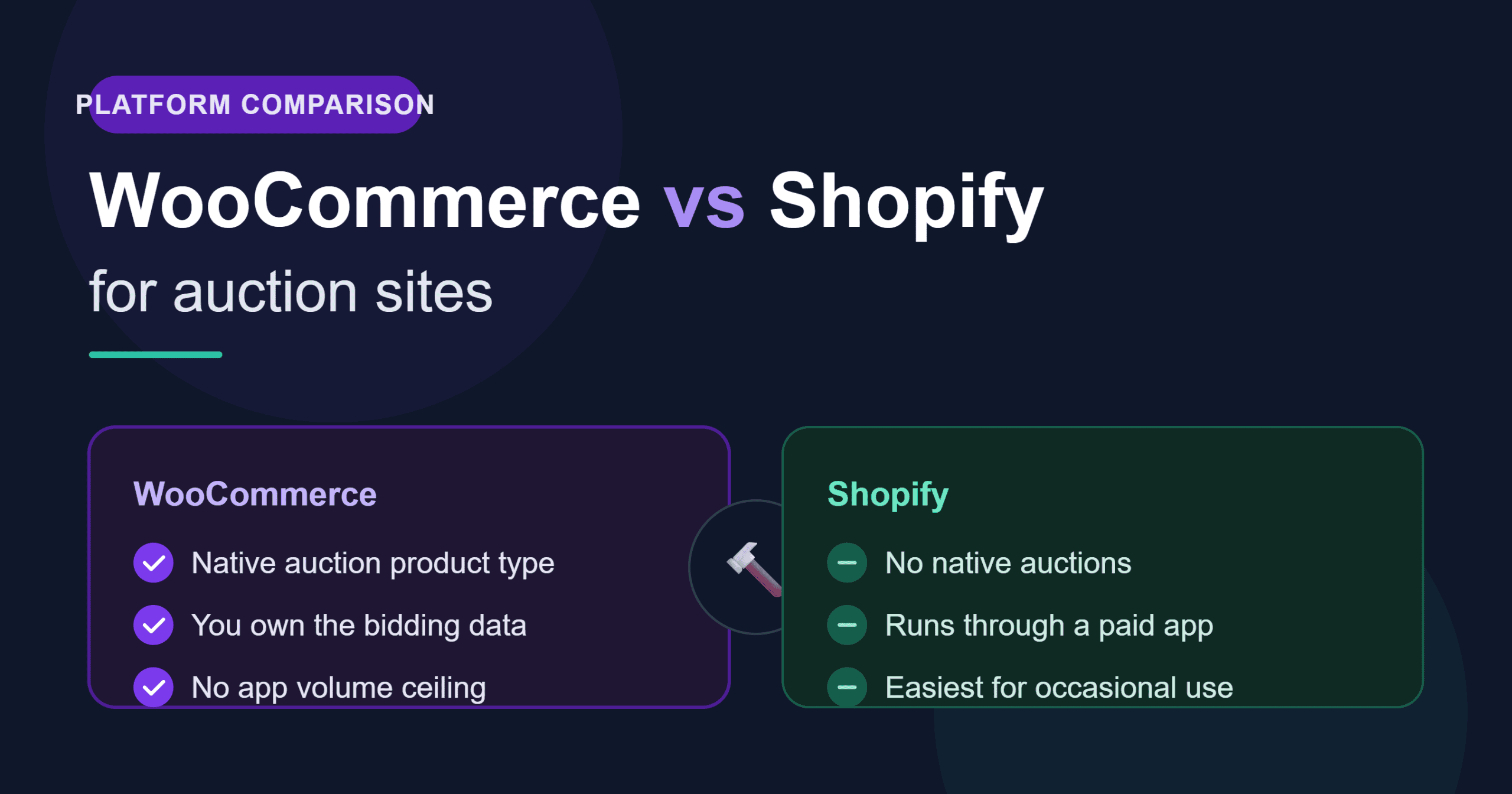
Shopify has no native auction feature. None. Every auction on a Shopify store runs through a third-party app, because the platform itself only knows how to sell at a set price. Guides that walk you through “setting up auctions on Shopify” are really walking you through installing an app, a point their own authors concede when they note the platform has no built-in way to hold auctions.
WooCommerce is the same at its core. The difference is what the add-on is allowed to do. A WooCommerce auction plugin registers auctions as a real product type inside your own store, so bids run through your existing checkout, tax and shipping. A Shopify auction app sits on top of a closed platform and works within whatever the App API permits. That single distinction drives almost everything below.
Where Shopify genuinely wins
Plenty, and pretending otherwise would waste your time.
Setup is faster and hosting is handled. Shopify runs the servers, security patches and uptime for you. There’s no WordPress to maintain, no plugin conflicts to debug at 2am. If you don’t have a developer, that’s worth real money.
It’s stronger for high-traffic general retail. Among the top one million ecommerce sites, Shopify leads with 28.8% to WooCommerce’s 18.2%, and Shopify merchants processed roughly $292 billion in sales in 2024. Large, fast-scaling brands land there for good reasons.
For occasional auctions, an app is fine. If bidding is a small side feature on an otherwise normal store, a Shopify auction app gets you there without touching a server. That’s a legitimate path, and for that use case it may be the right one.
Where WooCommerce pulls ahead for auctions
The moment auctions become the point of your site, not a side feature, the gap opens up.
You own the auction data
On WooCommerce, the bids, the auction product type and the bidding logic live in your own database on hosting you control. On Shopify, they live inside a third-party app running on a platform you rent. Leave the app, or leave Shopify, and your auction layer leaves with you. Ownership isn’t abstract when your whole business is the bidding history.
No app ceiling on volume
This is the one that bites at scale. When the auction marketplace Bids.com grew into thousands of products on Shopify, the App Store approach ran into API and frontend limits that capped auction creation at about eight per minute and slowed the site, and the fix was rebuilding off-platform as a custom application. A WooCommerce plugin talks straight to your store, so there’s no app sandbox sitting between your auctions and your database. High listing volume is where the architecture, not the marketing, decides the outcome.
The cost stops compounding
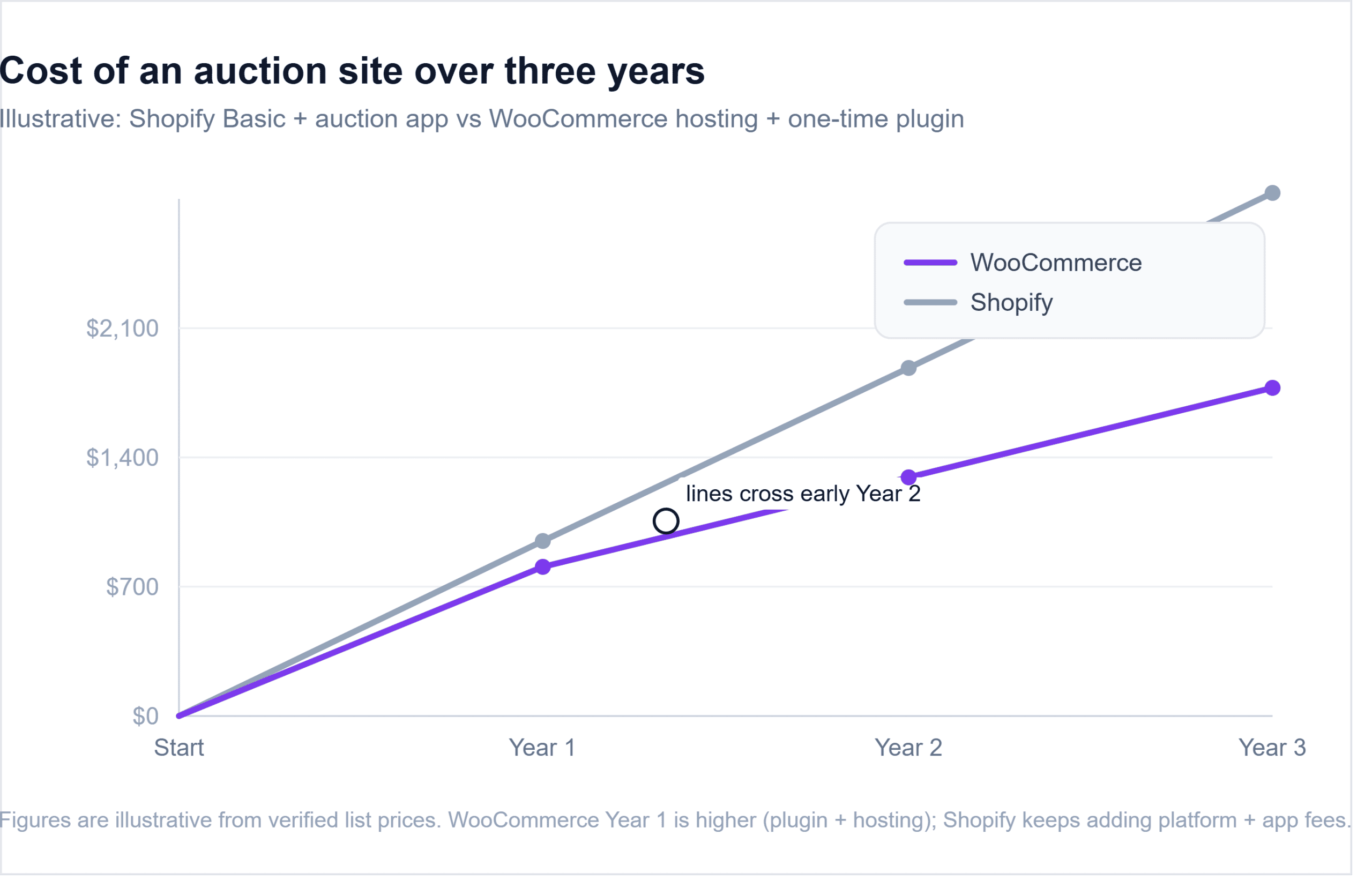
Shopify auction apps bill on a recurring 30-day cycle. Auction Pro, one of the better-rated ones, runs $240 per year, and that sits on top of Shopify’s Basic plan at $39 a month, or $468 a year billed monthly. WooCommerce itself is free and open-source. You pay for hosting, typically $20 to $100 a month, plus an auction plugin that can be a one-time purchase rather than a forever subscription.
| Cost item | Shopify | WooCommerce |
|---|---|---|
| Platform | $348–$468 / yr | Free, open-source |
| Hosting | Included | ~$240–$1,200 / yr |
| Auction tool | ~$240 / yr, recurring | Plugin, one-time or annual |
| Own your data | No, lives in the app | Yes, in your database |
| Volume ceiling | App API limits | None from an app layer |
The market picture
WooCommerce isn’t the underdog in this matchup. Counted by live stores, it’s the larger platform. StoreLeads recorded 4.34 million live WooCommerce stores against 2.84 million on Shopify in its May 2026 data, and WordPress runs about 43% of all websites. That scale is why WooCommerce has more auction plugins competing on depth and price than Shopify has auction apps, which is good news when you’re choosing a tool.
Live stores by platform
Source: StoreLeads, May 2026
Note: Shopify still leads among the top one million highest-traffic sites (28.8% vs 18.2%). Store count and high-traffic share tell different stories.
Which should you pick
Run a general store that auctions now and then, want zero server management, and expect modest bidding volume? Shopify plus an auction app is the simpler road, and the recurring fee won’t sting at low volume. That’s a real recommendation, not a consolation prize.
Building a site where bidding is the business, pushing high listing volume, or set on owning your data and capping your costs? WooCommerce is the stronger foundation. The native auction product type, the absence of an app ceiling, and a free platform all point the same direction.
Frequently asked questions
Does Shopify have built-in auction functionality?
No. Shopify has no native auction feature. Auctions on Shopify always run through a third-party app from the Shopify App Store, since the platform is designed to sell at fixed prices.
Can Shopify handle a high-volume auction site?
It can strain. Because auctions run through an app bound by Shopify’s API and frontend limits, large catalogs have hit ceilings on how fast auctions can be created and served. A documented case saw auction creation capped near eight per minute at thousands of products, prompting a rebuild off-platform.
Is WooCommerce actually cheaper for auctions?
Often, over time. WooCommerce is free and open-source, and many auction plugins offer one-time or annual pricing. Shopify stacks a monthly platform fee ($39 and up) on top of a recurring auction-app subscription, so costs keep accruing every month.
Which is easier to set up for a beginner?
Shopify. Hosting, security and updates are managed for you, so a non-technical user can launch faster. WooCommerce trades that convenience for control, ownership and lower long-term cost.



 Easy Setup
 5 Star Support

