

 Sep 23, 2026
  5 min read
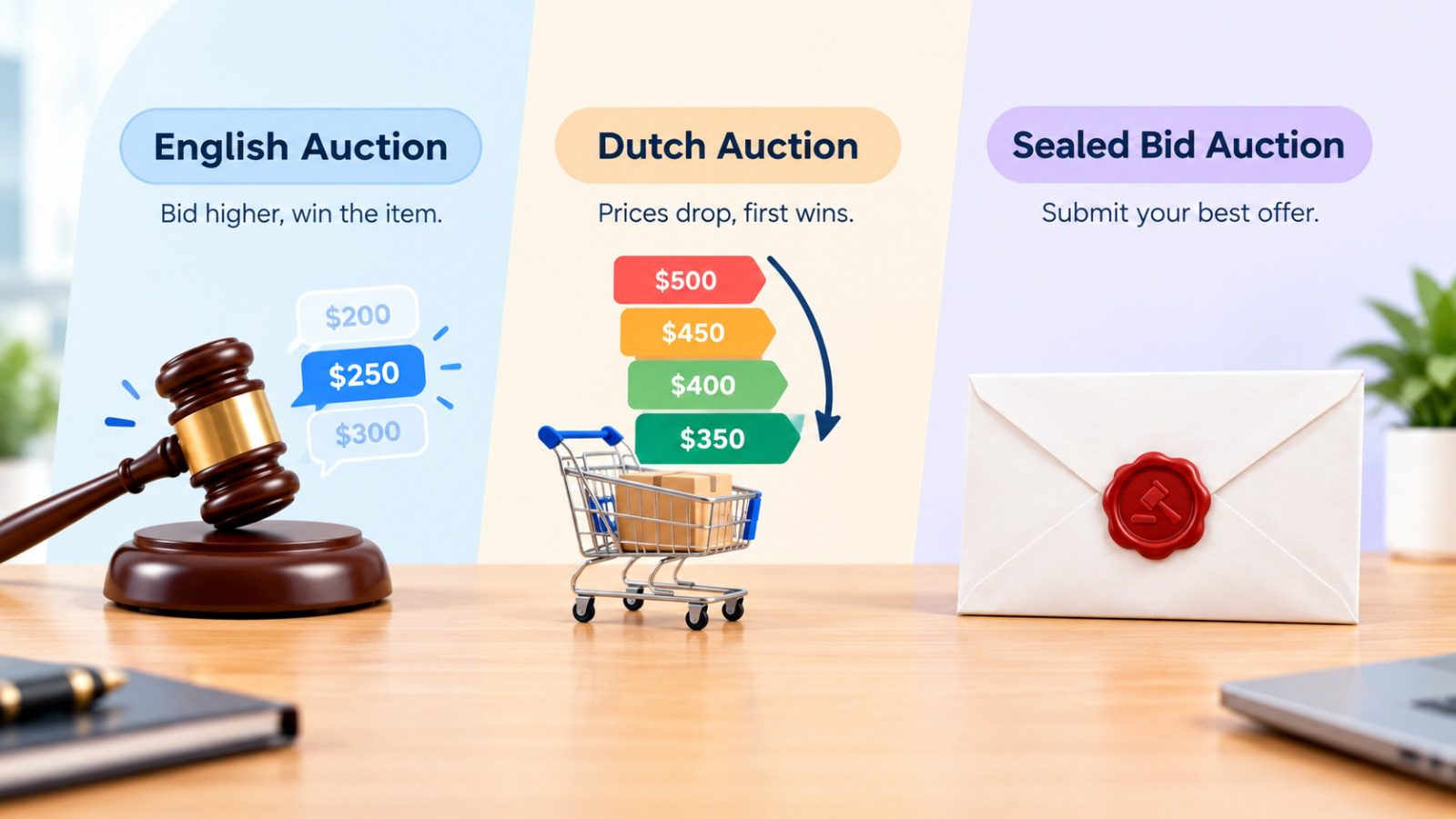
There are three main types of auctions: English (prices climb), Dutch (prices fall), and sealed bid (everyone bids once, in secret). Each one changes how people bid and how much you earn. This guide is for anyone setting up an auction site or choosing a format for a sale. You’ll learn how each type works and which one fits what you’re selling.
Quick answer: In an English auction, bidders raise the price until one person is left, and that person pays their final bid. In a Dutch auction, the price starts high and drops until the first bidder accepts it. In a sealed-bid auction, each bidder submits one private offer before a deadline, and the highest offer wins.
An English auction is open bidding where the price only goes up. The last bidder standing wins and pays their own final bid.
It’s the format most people picture, and it’s how eBay and most charity auctions work. The seller sets a starting price, and bidders raise it in fixed steps called bid increments. Everyone sees the current high bid, so people react to each other. Someone who planned to stop at $200 sees a rival hesitate at $210 and pushes to $230. That visibility is what lifts prices.
Online, most English auctions run on a timer. Many add auto-extensions, so a bid in the last few minutes pushes the end time back and nobody wins by sniping. Many also support proxy bidding, where the system bids for you up to a maximum you set. Sellers can add a hidden reserve price too, and our post on no reserve auctions covers how that works.
[PLACEHOLDER: Add a real example from a client site running English auctions: starting price, number of bids and final price.]
A Dutch auction runs the English format in reverse. The price starts high and drops on a schedule, and the first bidder to accept the current price wins.
The name comes from Dutch flower markets, where growers sell tulips and cut flowers this way. A large clock shows a falling price, and the first buyer to hit their button stops it and takes the lot. A whole lot can sell in seconds.
Bidders feel real tension. Wait for a lower price and you might lose to someone braver. Sellers like the format for stock that needs to move fast, such as perishables or many identical units. Google used a variation of it to price its 2004 IPO.
One thing trips people up. In the US, “Dutch auction” also describes a multi-unit format where all winners pay the same final price. Check which meaning a platform uses before you promise anything to bidders.
[PLACEHOLDER: Add a screenshot or example of a descending-price listing: starting price, drop interval and floor price.]
In a sealed-bid auction, every bidder submits one private offer before a deadline, and the highest offer wins. Nobody sees anyone else’s number until bidding closes.
Governments use this format for contracts and surplus property. Real estate sellers use it when several buyers want the same home. There’s no back-and-forth, no timer and no heat of the moment. Each bidder gets one shot, so they have to decide what the item is worth and commit.
That produces honest offers, but it can leave money on the table because nobody is pushed to go higher. It also creates the winner’s curse. With no information about rivals, the winner is often the person who overestimated the value the most.
There are two flavors. In a first-price auction, the winner pays their own bid. In a second-price version (a Vickrey auction), the winner pays the second-highest bid, which we explain in what is a second price auction. For a deeper look at hidden versus visible bidding, see sealed auction vs open bidding.
[PLACEHOLDER: Add a real sealed-bid example: item type, number of bids and the gap between the top two.]
The big differences are which way the price moves and whether bidders can see each other.
| English | Dutch | Sealed bid | |
|---|---|---|---|
| Price moves | Up | Down | Doesn’t move |
| Bidders see each other | Yes | Yes (the price) | No |
| Winner pays | Own final bid | Price at acceptance | Own bid (first-price) |
| Speed | Minutes to days | Seconds to minutes | Fixed deadline |
| Best for | Unique items | Stock that must move | High-value, formal sales |
| Main risk | Sniping, bidder fatigue | Price drops too far | Winner’s curse |
In theory, economists say these formats earn about the same on average if bidders are rational and value the item independently. That’s the revenue equivalence theorem. Real bidders get emotional, hate losing and copy each other, so the format you pick changes the outcome.
Run an English auction for unique items, a Dutch auction for stock that needs to move fast, and a sealed-bid auction when privacy or fairness matters more than excitement.
Here’s how we’d split it. Charity events, collectibles and art suit English, because competition does the work. Surplus inventory and bulk lots suit Dutch, because you get a fast sale and a clear floor. Land, heavy equipment and B2B deals suit sealed bid, because bidders keep their numbers private and you avoid a drawn-out contest.
For most WordPress auction sites, English is the right default. Bidders already know how it works, so you spend less time explaining rules. Some sellers mix formats, running a sealed round to shortlist buyers and then opening bidding between the finalists.
[PLACEHOLDER: Add data from your client sites, such as which format they choose most often.]
Most WordPress auction plugins handle English auctions well. Dutch and sealed-bid support varies, so check before you commit.
[PLACEHOLDER: Confirm which formats Ultimate Auction Pro supports today, add one sentence for each, and include a screenshot of the auction type setting.]
If you’re still comparing options, our WordPress bidding plugin guide shows how bidding works on a WooCommerce store.
Before you pick a format, list your top three items and ask one question for each: do you want competition, speed or privacy? That answer points to your format. Then set your starting price and increments. Our guide to proxy bidding vs manual bidding shows how to set the bidding rules for an English auction.


Nitesh Singh is an e-commerce software architect and the Founder of Inception Software LLP. He has 16+ years of software engineering experience and has been building dedicated auction extensions for the WordPress and WooCommerce ecosystems since 2014. Connect with Nitesh on LinkedIn to track his latest developments in automated bidding tech or read his setup guides on the site.
More articles by Nitesh Singh →


 Easy Setup
 5 Star Support