

 Jul 23, 2026
  8 min read
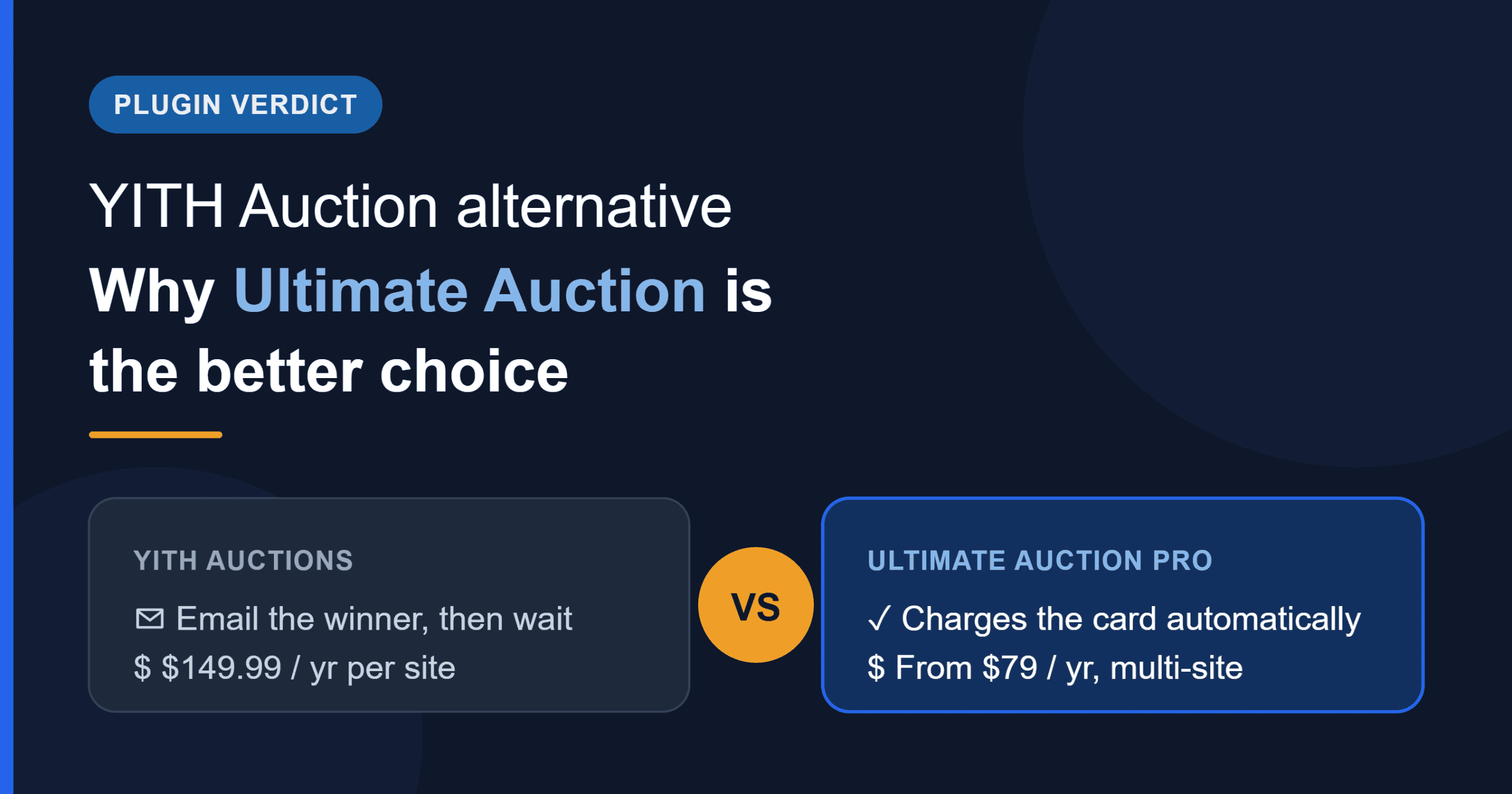
Most people don’t leave YITH because the plugin is bad. They leave because of what happens the moment an auction ends. YITH emails the winner and then stops, so if that person doesn’t pay, you’re the one sending reminders. This post makes the case that Ultimate Auction Pro is the better pick for stores running real bidding volume, and it’s honest about the one situation where staying on YITH still makes sense.
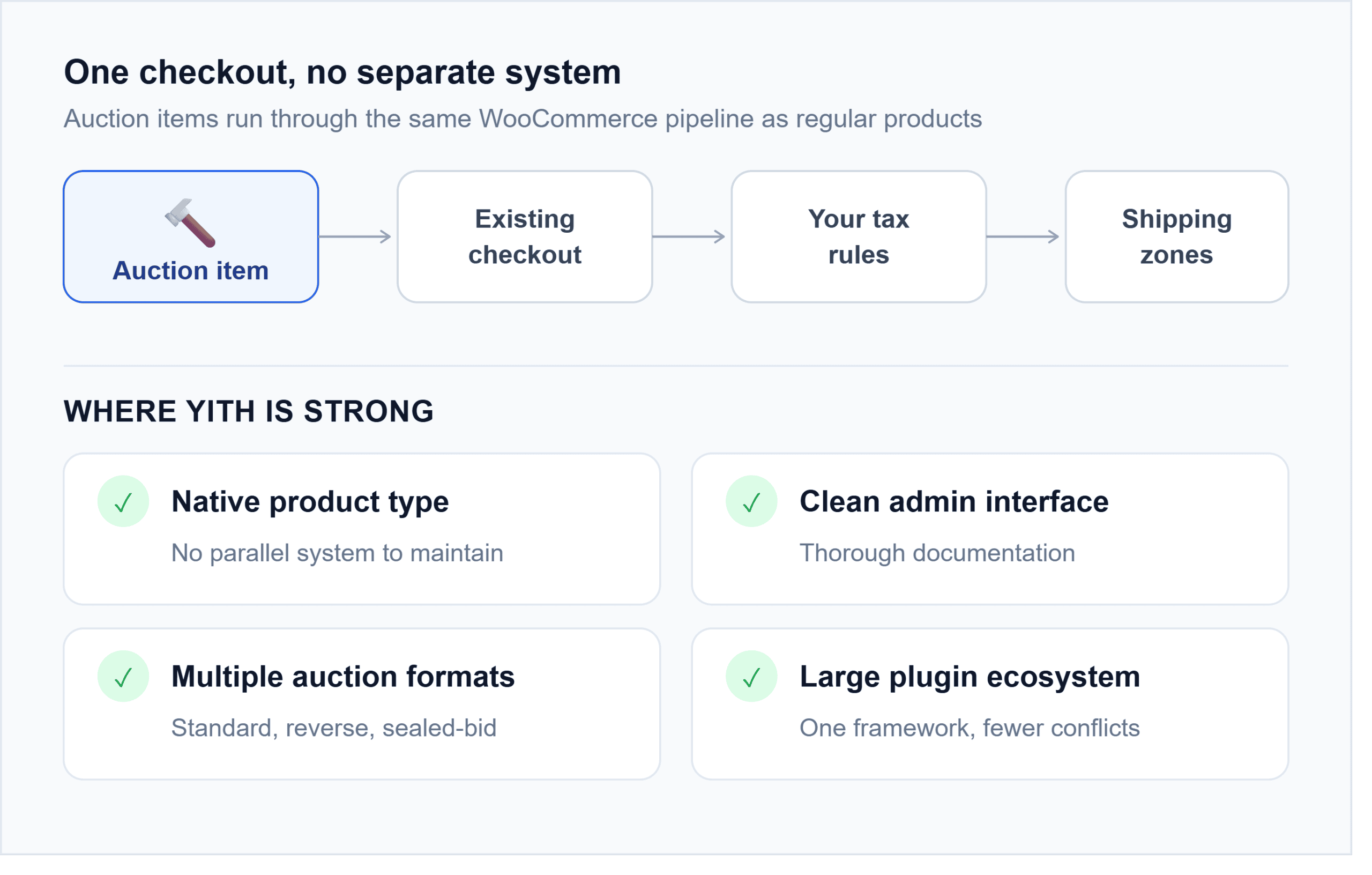
Credit where it’s due. YITH registers auctions as a native WooCommerce product type, so bids run through your existing checkout, tax rules, and shipping zones with no separate system bolted on. That’s the right architecture, and it’s why the plugin feels at home in a WooCommerce store from the first install.
The admin interface is clean. Documentation is thorough. It handles standard, reverse, and sealed-bid formats, and it auto-reschedules auctions that miss their reserve. YITH also sits inside one of the largest plugin ecosystems in WooCommerce, so if you already run several of their extensions, staying in one framework avoids compatibility headaches that cost real time. None of that is nothing.
Every strength in the last section holds right up until an auction ends. That’s the seam where YITH starts handing work back to you, and it gets heavier as your volume grows.
No automatic payment collection
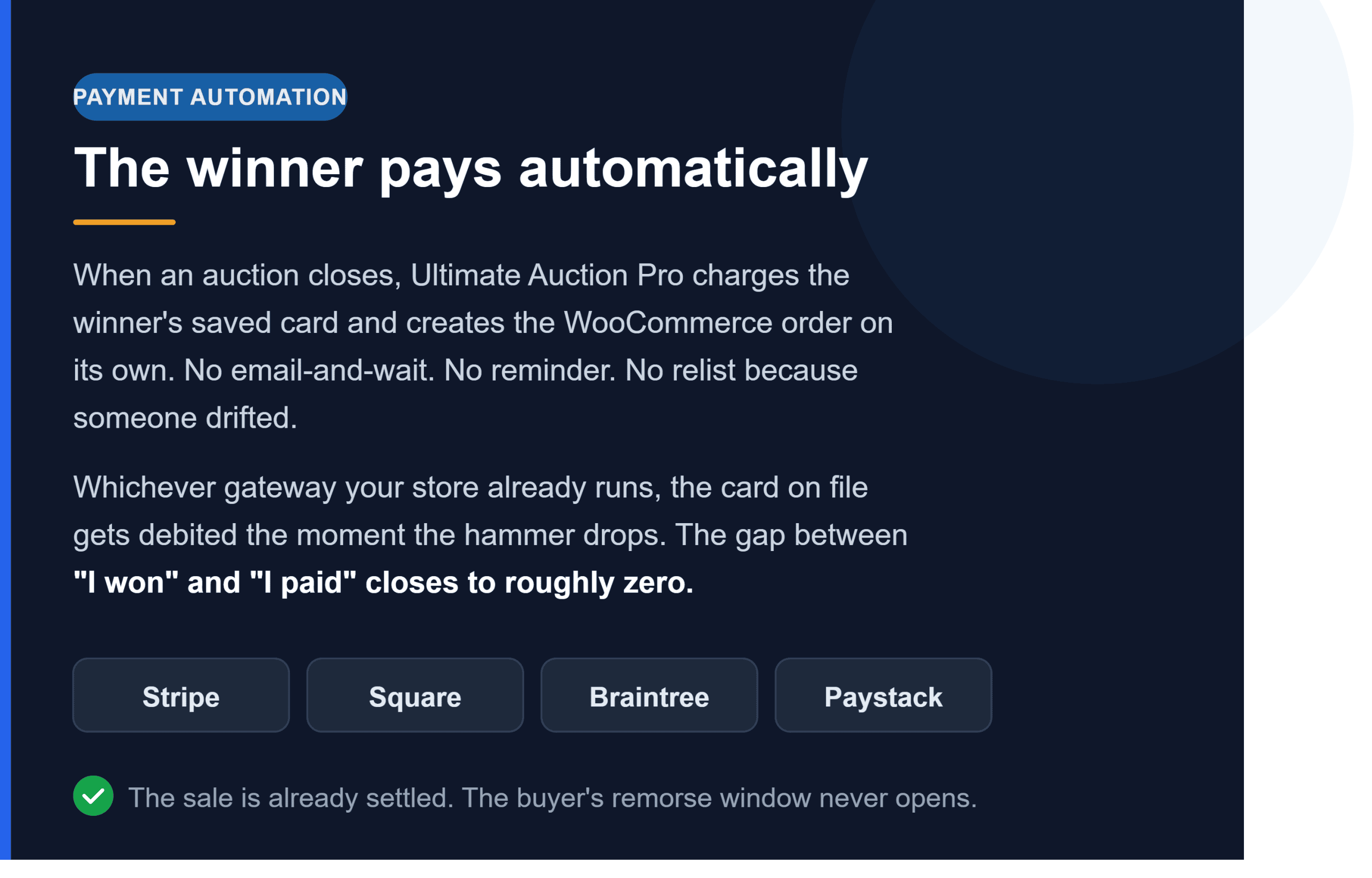
Here’s the sequence YITH runs when a hammer drops. It marks the winner, sends them an email, and waits. That’s the whole handoff. Payment depends entirely on the winner choosing to come back, log in, and check out.
Think about what that means at volume. Run twenty auctions a week and a chunk of those winners will drift. Some forget. Some have second thoughts once the competitive rush of bidding wears off. Some just miss the email in a full inbox. Every one of them becomes a manual follow-up: you checking who hasn’t paid, you sending the reminder, you deciding when to give up and relist. The auction did its job and created a sale, and then the plugin quietly makes that sale your problem to close.
Buyer’s remorse is real in auctions specifically, because bidding is emotional and checkout is not. The gap between “I won” and “I’ll pay now” is exactly where deals die. YITH does nothing to shrink that gap.
Per-site pricing that adds up
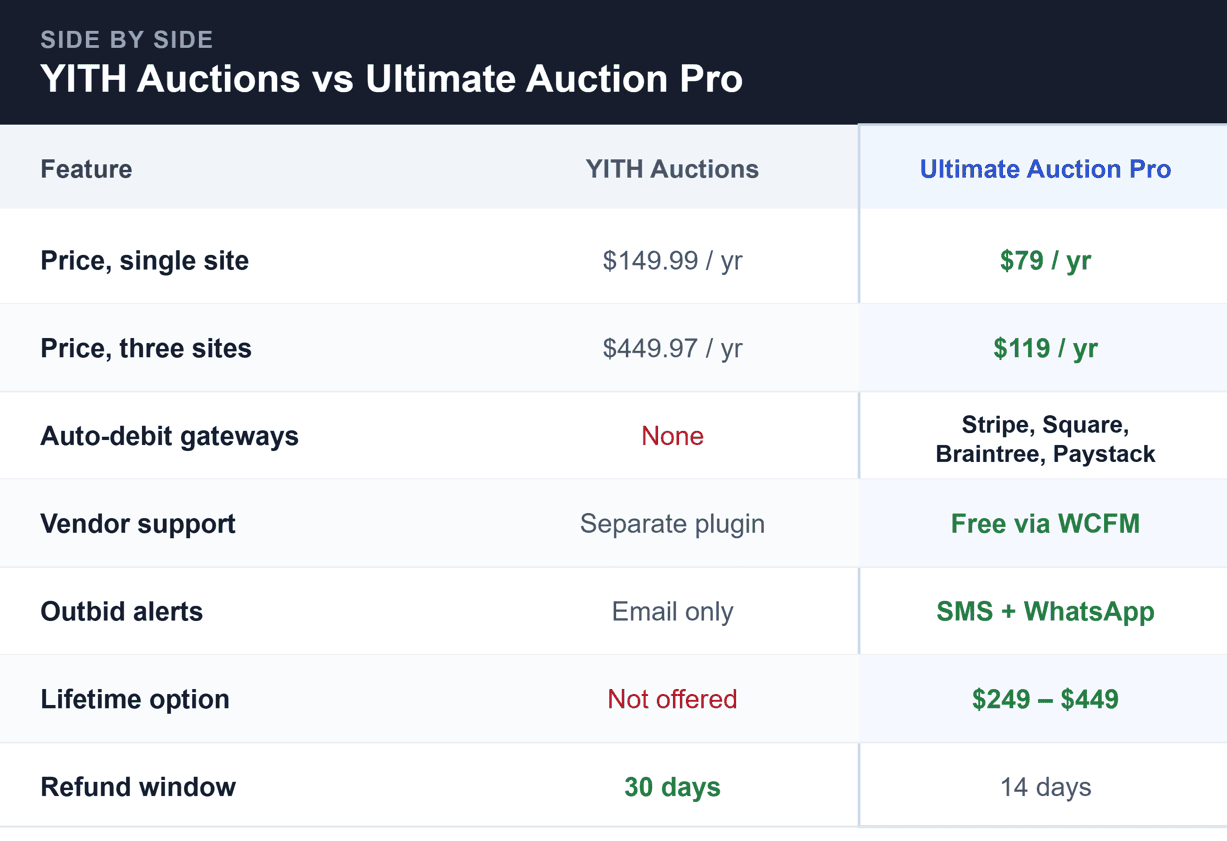
YITH Auctions runs $149.99 per year for a single site, a figure confirmed in our own hands-on plugin testing
For one store, fine. The math turns against you the moment there’s more than one site, because the licence is priced per installation. Build auction sites for clients and each one carries its own $149.99. Three client sites is $449.97 a year, every year, before you’ve added a single other extension. There’s no unlimited tier to cap that cost, so it scales in a straight line with the number of sites you manage. For a freelancer or a small agency, that line gets steep fast.
Take the three problems from the last section and answer them one at a time. That’s essentially what Ultimate Auction Pro was built to do.
Where YITH charges $149.99 per installation, Ultimate Auction Pro prices by tier and covers several sites at once. It’s $79/year for one site, $119/year for three, and $199/year for unlimited sites, per the Ultimate Auction Pro pricing page.
Look at what that does to the agency math from the last section. Three client sites on YITH cost $449.97 a year. The same three on Ultimate Auction Pro’s Business tier cost $119. And if you’re past three sites, the unlimited plan at $199 covers all of them for less than a third of what two YITH licences would run. Lifetime licences exist too, at $249, $349 and $449, so the cost can stop recurring entirely.
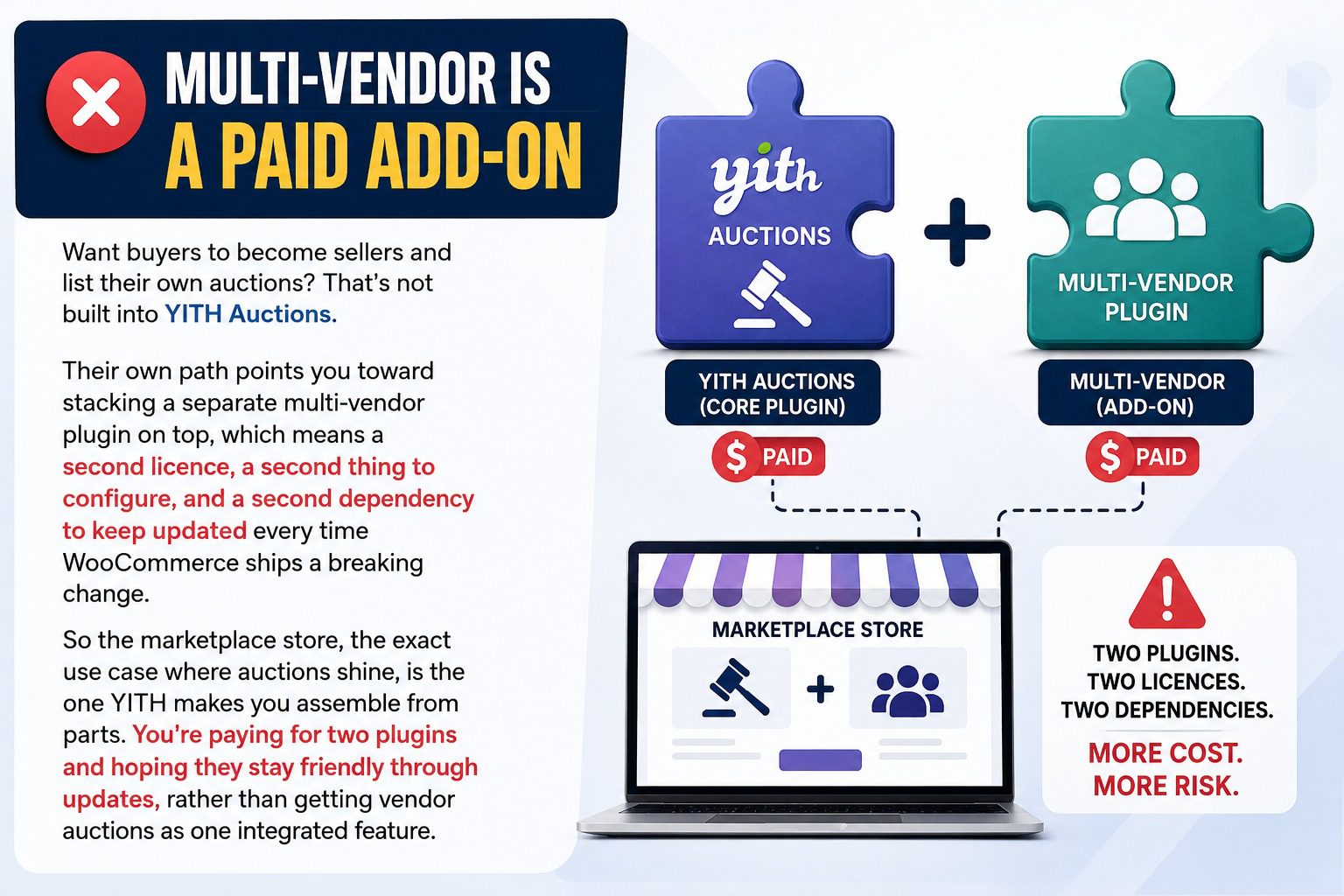
Remember YITH making you stack a separate multi-vendor plugin? Ultimate Auction Pro integrates with WCFM Marketplace, which is free. Your sellers list their own auctions, you take your cut, and it costs nothing beyond the licence you already bought. One less plugin to pay for, one less dependency to babysit through updates.

Ultimate Auction Pro isn’t the right answer for everyone, and a comparison that pretended otherwise wouldn’t be worth reading. Here’s where it costs you something.
The headline features aren’t in the cheapest plan. Proxy bidding, anti-sniping, and Buy Now all sit in the Business tier at $119/year, not the $79 Starter. So the fair fight is $119 against YITH’s $149.99, not $79 against it. Still cheaper, and still covers three sites to YITH’s one, but quote the number that actually gets you the features you’re comparing.
Vendor auctions mean installing WCFM yourself. The integration is free, which is the win from the last section, but WCFM is a separate plugin you set up and maintain alongside Ultimate Auction Pro. It’s one fewer license than YITH’s multi-vendor route, not one fewer plugin.
And the settings panel is busier. Ultimate Auction Pro exposes more configuration than YITH does, which is exactly why it can do more, and also why the admin screen takes longer to learn. If you value a minimal interface over granular control, YITH’s cleaner panel is a genuine point in its favor. That tradeoff runs in YITH’s direction, not ours.
None of these are dealbreakers for a store running real auction volume. But you should know them going in, rather than discovering them after you’ve bought.
Side-by-side comparison
Here’s the whole comparison in one view. Green marks the stronger option in each row, and note that the refund window is one place YITH comes out ahead.
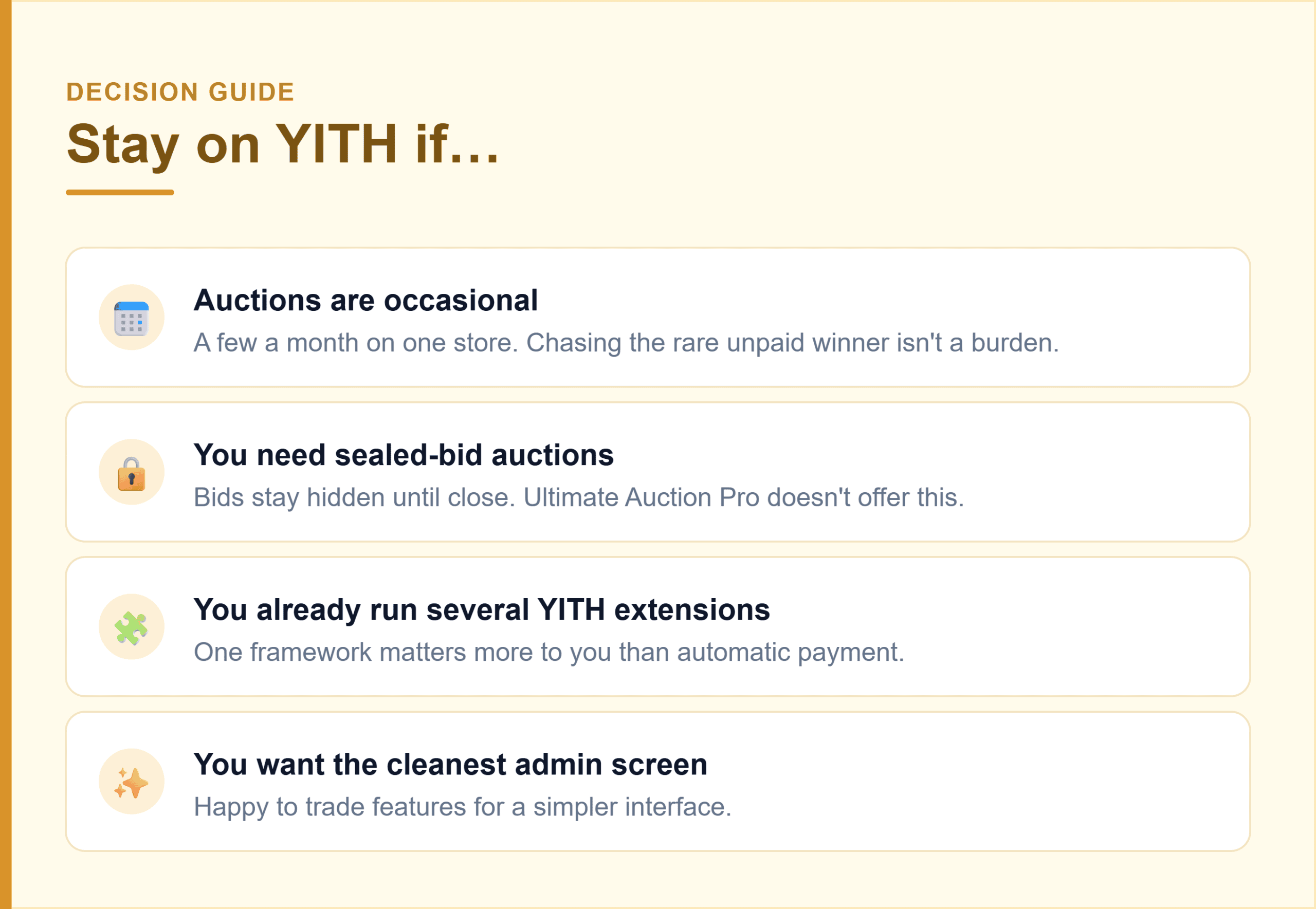
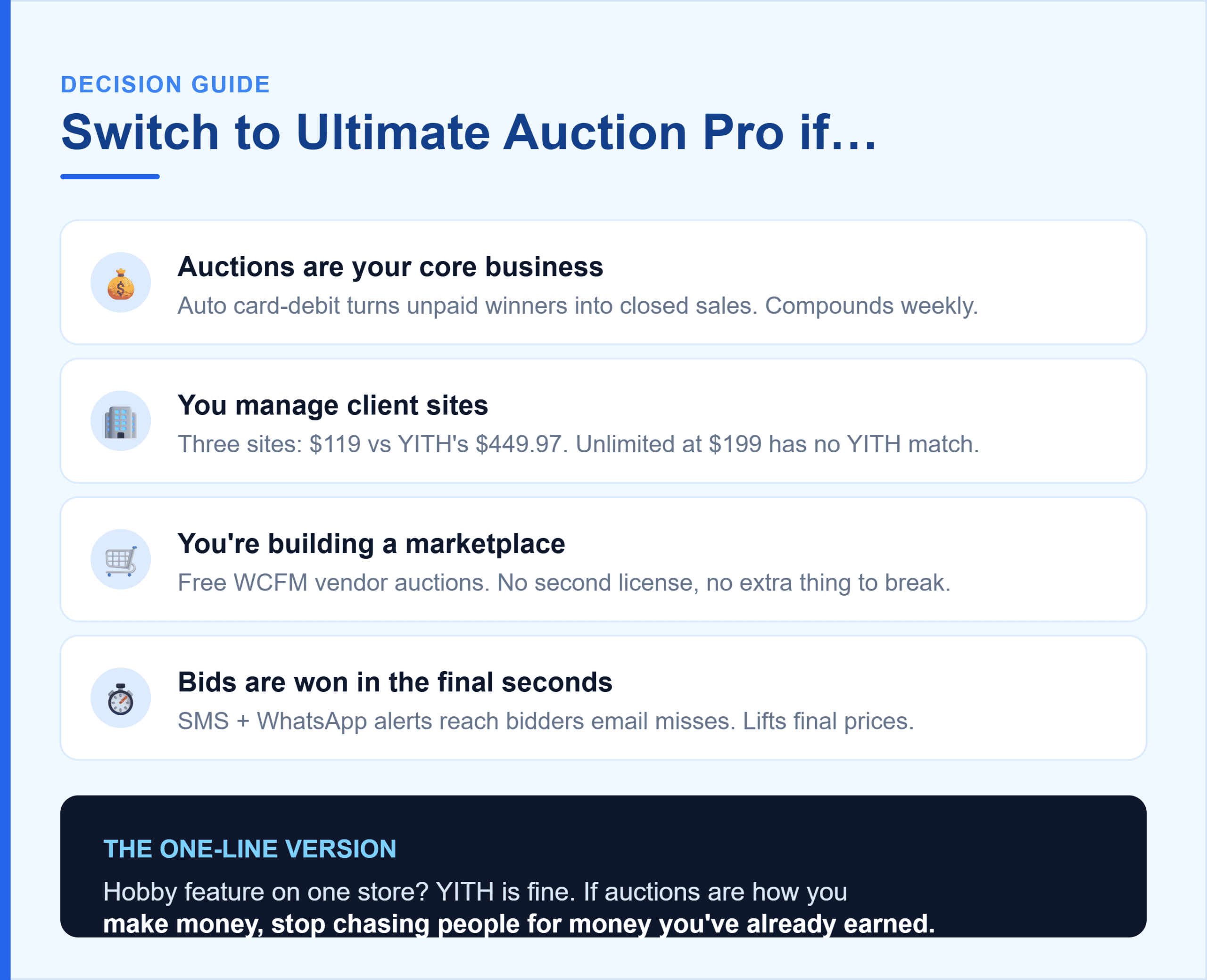
The one-line version: if auctions are a hobby feature on a single store, YITH is fine, and switching isn’t worth the effort. If auctions are how you make money, or how your clients make theirs, Ultimate Auction Pro pays for the switch quickly and then keeps paying. The deciding question isn’t which has more features. It’s whether you’re still willing to chase people for money you’ve already earned.
If you’re weighing options beyond YITH, two more plugins come up often, and both fill different needs than Ultimate Auction Pro.
The oldest auction plugin in the WooCommerce world. Its CodeCanyon listing notes it launched on 13 February 2014 and has passed 8,000 sales, with over a decade of active development behind it. It sells for $55 on a single-domain license and handles regular, proxy, sealed and reverse auctions, plus anti-sniping.
It even does automatic card charging for won auctions, which is the feature YITH lacks. The catch is Stripe only. If your buyers pay through any other gateway, that automation disappears, and multi-vendor needs a separate plugin like WC Vendors or Dokan on top. Good pick for a single Stripe-based store on a tight budget. Less so for anything bigger.
A lighter, cheaper option built around a clean auction product type. It supports normal, reverse, silent and proxy auctions, lets you set starting bid, increments, reserve, Buy Now, start and end times, and includes anti-sniping that extends the clock when a last-second bid lands.
Where it stops is payment and vendors. There’s no automatic card debit and no built-in marketplace path, so it fits occasional auctions, a charity fundraiser or a small store testing the format, rather than a business that lives on bidding volume. Its appeal is simplicity and low cost, not depth.


Nitesh Singh is an e-commerce software architect and the Founder of Inception Software LLP. He has 16+ years of software engineering experience and has been building dedicated auction extensions for the WordPress and WooCommerce ecosystems since 2014. Connect with Nitesh on LinkedIn to track his latest developments in automated bidding tech or read his setup guides on the site.
More articles by Nitesh Singh →




 Easy Setup
 5 Star Support